
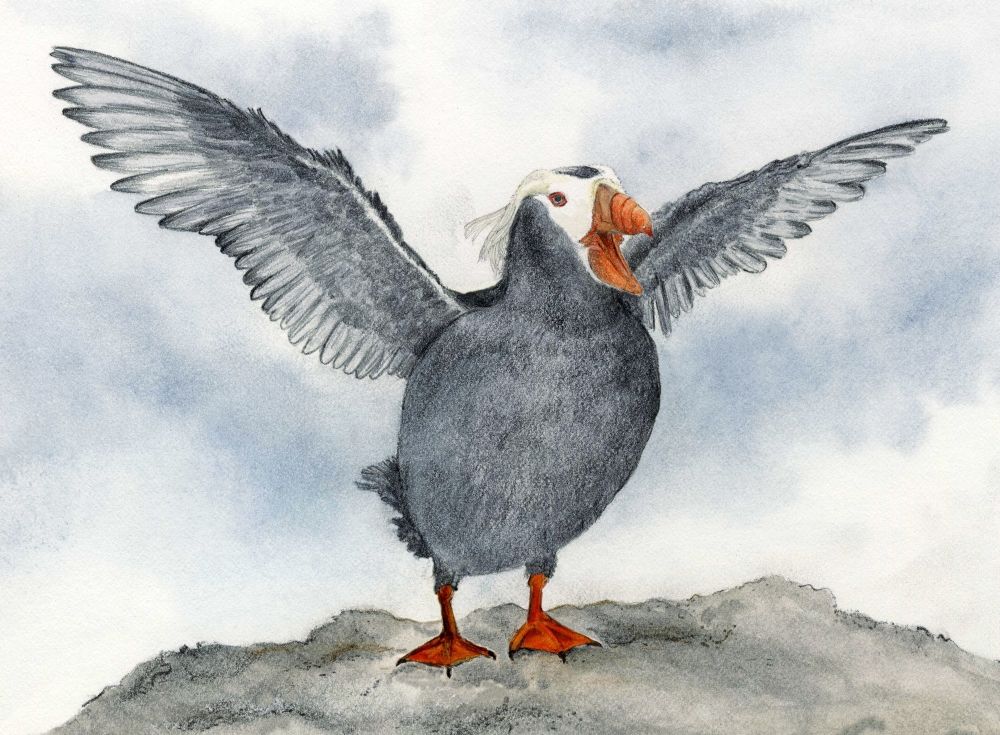
Tufted Puffin
Latin name: Fratercula Cirrhata,Conservsation status: vulnerable (population is decreasing)
Puffins dive as deep as 200 ft. for food, stay under water for more than a minute, and fly up to 40 mph.
Tufted Puffins are threatened by sea level rise and storm surges which destroy habitats and breeding areas. In some areas of North America warming seas are causing the fish that the Puffins feed on to migrate farther north, making it difficult for them to find adequate food. Other threats are entrapment in fishing nets, oil spills, pollution, ingestion of plastic, human disturbance of breeding colonies and introduced predators such as rats and foxes.
Other animals at risk

Polar Bear
Polar Bears live only in the Arctic. Loss of sea ice has a critically adverse effect on Polar Bears. They hunt from the edge and build snow dens on the ice for resting and raising their cubs. Sea ice decline could open the Arctic to shipping and tourism, further disturbing Arctic habitats. Other threats are oil development and industrial pollution that reaches the Arctic through air and ocean currents.
Polar Bears live only in the Arctic. Loss of sea ice has a critically adverse effect on Polar Bears. They hunt from the edge and build snow dens on the ice for resting and raising their cubs. Sea ice decline could open the Arctic to shipping and tourism, further disturbing Arctic habitats. Other threats are oil development and industrial pollution that reaches the Arctic through air and ocean currents.

Tufted Puffin
Tufted Puffins are threatened by sea level rise and storm surges which destroy habitats and breeding areas. In some areas of North America warming seas are causing the fish that the Puffins feed on to migrate farther north, making it difficult for them to find adequate food. Other threats are entrapment in fishing nets, oil spills, pollution, ingestion of plastic, human disturbance of breeding colonies and introduced predators such as rats and foxes.
Tufted Puffins are threatened by sea level rise and storm surges which destroy habitats and breeding areas. In some areas of North America warming seas are causing the fish that the Puffins feed on to migrate farther north, making it difficult for them to find adequate food. Other threats are entrapment in fishing nets, oil spills, pollution, ingestion of plastic, human disturbance of breeding colonies and introduced predators such as rats and foxes.
Sockeye Salmon
For decades wild salmon populations have been in decline from human causes: over fishing; habitat degradation—logging, mining, agriculture and dams; pollution; and interaction with hatchery or farmed salmon. These conditions and threats may hinder their ability to adapt to the effects of climate change. Salmon thrive at specific freshwater temperatures—warming air raises water temperature. Early snow melt and increased rains cause physical changes to spawning streams.
For decades wild salmon populations have been in decline from human causes: over fishing; habitat degradation—logging, mining, agriculture and dams; pollution; and interaction with hatchery or farmed salmon. These conditions and threats may hinder their ability to adapt to the effects of climate change. Salmon thrive at specific freshwater temperatures—warming air raises water temperature. Early snow melt and increased rains cause physical changes to spawning streams.
Arctic Fox
The Arctic tundra is a region of shrubs, grasses and permanently frozen subsoil. Warming could change the tundra to boreal forest—habitat for the Red Fox. The Red Fox, a predator and a competitor for food, is already beginning to migrate north into the Arctic Fox's territory. Milder tundra weather also causes changes in the population of lemmings and rodents—main food for the Arctic Fox.
The Arctic tundra is a region of shrubs, grasses and permanently frozen subsoil. Warming could change the tundra to boreal forest—habitat for the Red Fox. The Red Fox, a predator and a competitor for food, is already beginning to migrate north into the Arctic Fox's territory. Milder tundra weather also causes changes in the population of lemmings and rodents—main food for the Arctic Fox.
The Tufted Puffin is at risk from climate change because of:The Tufted Puffin is also threatened by: