
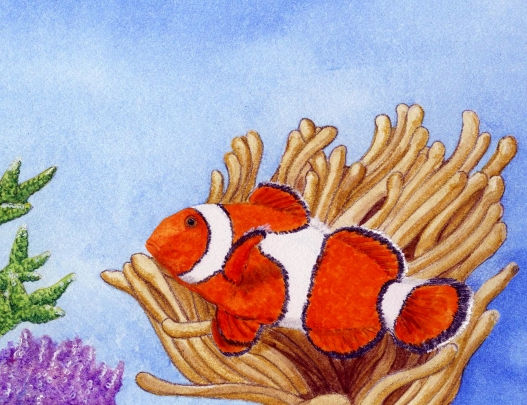
Common Clownfish
Latin name: Amphiprion Ocellaris,Conservsation status: least concern (population is stable)
All Clownfish are born male but some will switch gender to become the dominant female in a group. For protection, they hide among anemone, immune to their poison.
Clownfish live in the shallow waters of coral reefs where they have a mutually beneficial relation with a few species of sea anemone. The anenome protects the Clownfish, and the fish's swimming aerates the water around the anenome. Clownfish are unable to move long distances, and rising ocean temperature and acidity is a threat to their coral reef habitats. Increased acidity also seems to impair their ability to navigate to their home anemones.
Other animals at risk
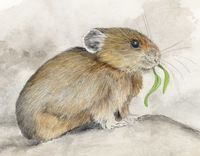
American Pika
Pikas live primarily in cool micro-climates on rocky slopes, feeding in adjacent meadows. Warmer temperatures and reduced snowpack are the main threats. Some Pikas may move to higher, cooler regions if there is enough vegetation. Pikas living in lower, warmer regions are at risk if they attempt to move to other regions as they are extremely sensitive to heat—more than two hours in temperatures over 78 °F can be lethal. Without enough winter snow for insulation, Pikas will freeze.
Pikas live primarily in cool micro-climates on rocky slopes, feeding in adjacent meadows. Warmer temperatures and reduced snowpack are the main threats. Some Pikas may move to higher, cooler regions if there is enough vegetation. Pikas living in lower, warmer regions are at risk if they attempt to move to other regions as they are extremely sensitive to heat—more than two hours in temperatures over 78 °F can be lethal. Without enough winter snow for insulation, Pikas will freeze.
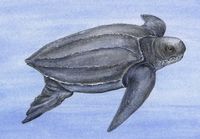
Leatherback Sea Turtle
Climate change impacts the Leatherback in two main ways: an increase in the temperature of nesting sands causes a greater proportion of females to hatch, destabilizing future populations; and sea level rise and stronger, more frequent storms erode nesting beaches and wash away eggs and hatchlings. The Leatherback is also threatened from fisheries by-catch, egg collection, coastal development, pollution and ingestion of floating plastics.
Climate change impacts the Leatherback in two main ways: an increase in the temperature of nesting sands causes a greater proportion of females to hatch, destabilizing future populations; and sea level rise and stronger, more frequent storms erode nesting beaches and wash away eggs and hatchlings. The Leatherback is also threatened from fisheries by-catch, egg collection, coastal development, pollution and ingestion of floating plastics.
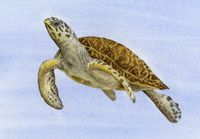
Hawksbill Sea Turtle
Climate change may affect Hawksbill Turtles in various ways because they live in different habitats at different stages of life: open ocean, beaches, lagoons and coral reefs. Rising sand temperature of nesting beaches produces more females and other abnormalities in baby turtles. Adults live primarily in coral reefs—threatened by rising ocean temperature and acidity. Since ancient times the Hawksbill has been exploited for its shell. They are also threatened from fisheries by-catch, development, and a high sensitivity to oil spills. The population has decreased by an estimated 80% in the last 100 years.
Climate change may affect Hawksbill Turtles in various ways because they live in different habitats at different stages of life: open ocean, beaches, lagoons and coral reefs. Rising sand temperature of nesting beaches produces more females and other abnormalities in baby turtles. Adults live primarily in coral reefs—threatened by rising ocean temperature and acidity. Since ancient times the Hawksbill has been exploited for its shell. They are also threatened from fisheries by-catch, development, and a high sensitivity to oil spills. The population has decreased by an estimated 80% in the last 100 years.

Ivory Gull
Ivory Gulls are almost entirely dependent on sea ice and glaciers for nesting and food foraging. They feed on fish and shellfish that thrive near the edge of the ice, and on the remains of seals left by Polar Bears. Seal blubber is a source of heavy contaminants—Ivory Gull eggs show a higher concentration of mercury and pesticides than any Arctic sea bird. Other threats are illegal hunting and disturbance from diamond mining in the Canadian Arctic.
Ivory Gulls are almost entirely dependent on sea ice and glaciers for nesting and food foraging. They feed on fish and shellfish that thrive near the edge of the ice, and on the remains of seals left by Polar Bears. Seal blubber is a source of heavy contaminants—Ivory Gull eggs show a higher concentration of mercury and pesticides than any Arctic sea bird. Other threats are illegal hunting and disturbance from diamond mining in the Canadian Arctic.
The Common Clownfish is at risk from climate change because of: