
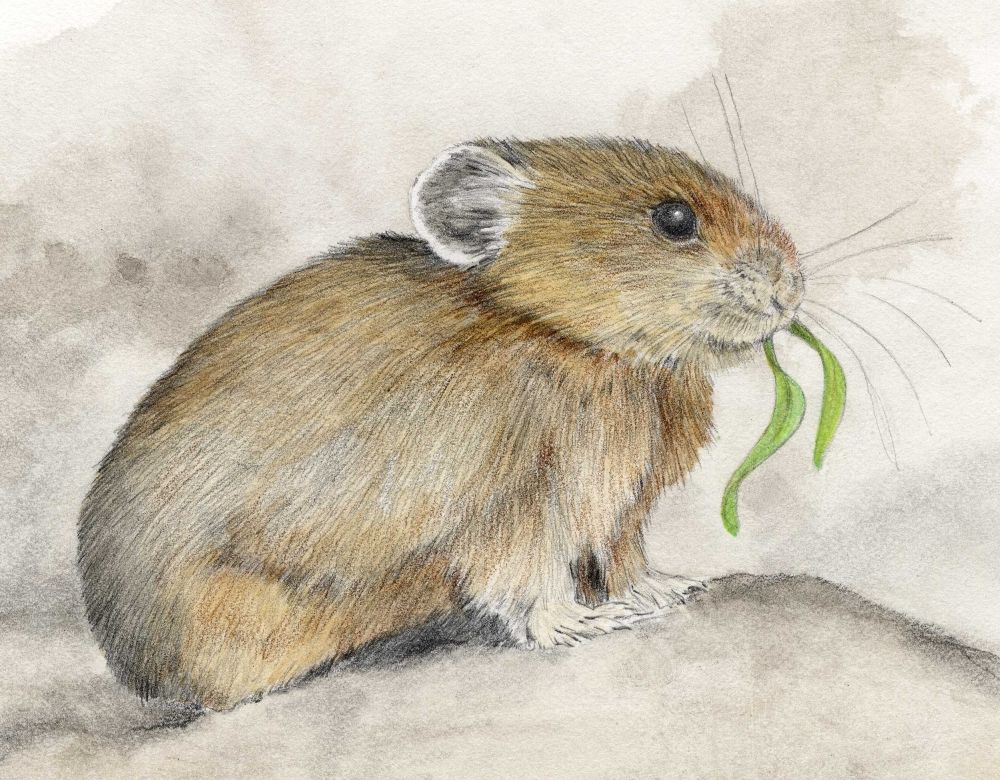
American Pika
Latin name: Ochotona Princeps,Conservsation status: least concern (population is decreasing)
Pikas, also called "whistling hares" because of their loud song, feed in winter on dried haypiles they have stored near the entrance to their burrows. When haying during late summer they may make up to 100 trips a day.
Pikas live primarily in cool micro-climates on rocky slopes, feeding in adjacent meadows. Warmer temperatures and reduced snowpack are the main threats. Some Pikas may move to higher, cooler regions if there is enough vegetation. Pikas living in lower, warmer regions are at risk if they attempt to move to other regions as they are extremely sensitive to heat—more than two hours in temperatures over 78 °F can be lethal. Without enough winter snow for insulation, Pikas will freeze.
Other animals at risk

Ringed Seal
All populations of Ringed Seals are expected to be adversely affected by climate change because of dependence on sea ice and snow dens for breeding, protecting pups, moulting and resting. Early warming causes pups to separate prematurely from their mothers. As sea ice declines, other threats are fisheries by-catch, increased shipping, tourism and development. Seals are vulnerable to disease from heavy concentrations of pollutants that have accumulated in the Arctic food web.
All populations of Ringed Seals are expected to be adversely affected by climate change because of dependence on sea ice and snow dens for breeding, protecting pups, moulting and resting. Early warming causes pups to separate prematurely from their mothers. As sea ice declines, other threats are fisheries by-catch, increased shipping, tourism and development. Seals are vulnerable to disease from heavy concentrations of pollutants that have accumulated in the Arctic food web.
Black-footed Albatross
Almost all Black Footed Albatrosses live in the Hawaiian Islands. Like all species of albatrosses that breed on low lying beaches and slopes, they are highly susceptible to sudden flooding from sea level rise and storm surges. Thousands each year are caught by longline fishing and they are also threatened by pollution and ingesting plastics that float in the ocean.
Almost all Black Footed Albatrosses live in the Hawaiian Islands. Like all species of albatrosses that breed on low lying beaches and slopes, they are highly susceptible to sudden flooding from sea level rise and storm surges. Thousands each year are caught by longline fishing and they are also threatened by pollution and ingesting plastics that float in the ocean.
Leatherback Sea Turtle
Climate change impacts the Leatherback in two main ways: an increase in the temperature of nesting sands causes a greater proportion of females to hatch, destabilizing future populations; and sea level rise and stronger, more frequent storms erode nesting beaches and wash away eggs and hatchlings. The Leatherback is also threatened from fisheries by-catch, egg collection, coastal development, pollution and ingestion of floating plastics.
Climate change impacts the Leatherback in two main ways: an increase in the temperature of nesting sands causes a greater proportion of females to hatch, destabilizing future populations; and sea level rise and stronger, more frequent storms erode nesting beaches and wash away eggs and hatchlings. The Leatherback is also threatened from fisheries by-catch, egg collection, coastal development, pollution and ingestion of floating plastics.
Rusty Patched Bumble Bee
The Rusty Patched is the first bee to be listed as endangered in the US. Populations have declined as much as 87% from habitat loss, disease and pesticides. Climate threats include: warming and precipitation, early snow, late frost and drought. Bees and butterflies are important agricultural pollinators. In 2016, 40% of invertebrate pollinators (bees and butterflies) were listed as threatened with extinction.
The Rusty Patched is the first bee to be listed as endangered in the US. Populations have declined as much as 87% from habitat loss, disease and pesticides. Climate threats include: warming and precipitation, early snow, late frost and drought. Bees and butterflies are important agricultural pollinators. In 2016, 40% of invertebrate pollinators (bees and butterflies) were listed as threatened with extinction.
The American Pika is at risk from climate change because of: