
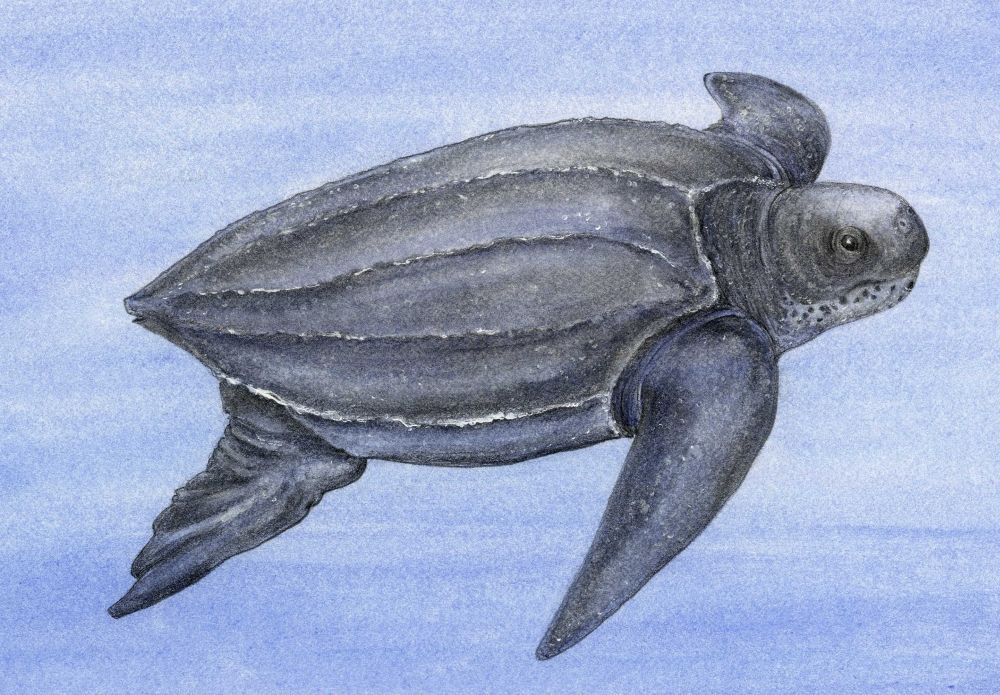
Leatherback Sea Turtle
Latin name: Dermochelys Coriacea,Conservsation status: vulnerable (population is decreasing)
The largest of all sea turtles, the Leatherback has been on Earth since the dinosaurs—100 million years. It can grow over six feet long, weigh up to one ton, and dive over 3,000 feet—deeper than any other turtle.
Climate change impacts the Leatherback in two main ways: an increase in the temperature of nesting sands causes a greater proportion of females to hatch, destabilizing future populations; and sea level rise and stronger, more frequent storms erode nesting beaches and wash away eggs and hatchlings. The Leatherback is also threatened from fisheries by-catch, egg collection, coastal development, pollution and ingestion of floating plastics.
Other animals at risk
Adelie Penguin
In winter, the sun doesn't rise south of the Antarctic Circle. If Antarctic sea ice decreases and does not extend far enough to the north, Adélie Penguins, during their winter migration, may not be able to reach the sunlight needed to navigate, hunt and avoid predators—they won't dive in the dark. Other threats are oil pollution, fishing and disturbance of colonies from research stations and aircraft.
In winter, the sun doesn't rise south of the Antarctic Circle. If Antarctic sea ice decreases and does not extend far enough to the north, Adélie Penguins, during their winter migration, may not be able to reach the sunlight needed to navigate, hunt and avoid predators—they won't dive in the dark. Other threats are oil pollution, fishing and disturbance of colonies from research stations and aircraft.

Beluga
Belugas live in Arctic and Sub-Arctic waters. Impacts from climate change include: an increase in ship traffic as sea ice declines, oil exploration and extraction, fisheries by-catch, and disruption of the food web. As Arctic waters warm and currents change, the Humpback (a competitor) and the Orca (a predator) may move north and stay longer. Some Beluga populations are also threatened by hunting, pollution and habitat loss.
Belugas live in Arctic and Sub-Arctic waters. Impacts from climate change include: an increase in ship traffic as sea ice declines, oil exploration and extraction, fisheries by-catch, and disruption of the food web. As Arctic waters warm and currents change, the Humpback (a competitor) and the Orca (a predator) may move north and stay longer. Some Beluga populations are also threatened by hunting, pollution and habitat loss.
American Pika
Pikas live primarily in cool micro-climates on rocky slopes, feeding in adjacent meadows. Warmer temperatures and reduced snowpack are the main threats. Some Pikas may move to higher, cooler regions if there is enough vegetation. Pikas living in lower, warmer regions are at risk if they attempt to move to other regions as they are extremely sensitive to heat—more than two hours in temperatures over 78 °F can be lethal. Without enough winter snow for insulation, Pikas will freeze.
Pikas live primarily in cool micro-climates on rocky slopes, feeding in adjacent meadows. Warmer temperatures and reduced snowpack are the main threats. Some Pikas may move to higher, cooler regions if there is enough vegetation. Pikas living in lower, warmer regions are at risk if they attempt to move to other regions as they are extremely sensitive to heat—more than two hours in temperatures over 78 °F can be lethal. Without enough winter snow for insulation, Pikas will freeze.
Arctic Fox
The Arctic tundra is a region of shrubs, grasses and permanently frozen subsoil. Warming could change the tundra to boreal forest—habitat for the Red Fox. The Red Fox, a predator and a competitor for food, is already beginning to migrate north into the Arctic Fox's territory. Milder tundra weather also causes changes in the population of lemmings and rodents—main food for the Arctic Fox.
The Arctic tundra is a region of shrubs, grasses and permanently frozen subsoil. Warming could change the tundra to boreal forest—habitat for the Red Fox. The Red Fox, a predator and a competitor for food, is already beginning to migrate north into the Arctic Fox's territory. Milder tundra weather also causes changes in the population of lemmings and rodents—main food for the Arctic Fox.
The Leatherback Sea Turtle is at risk from climate change because of:The Leatherback Sea Turtle is also threatened by: