
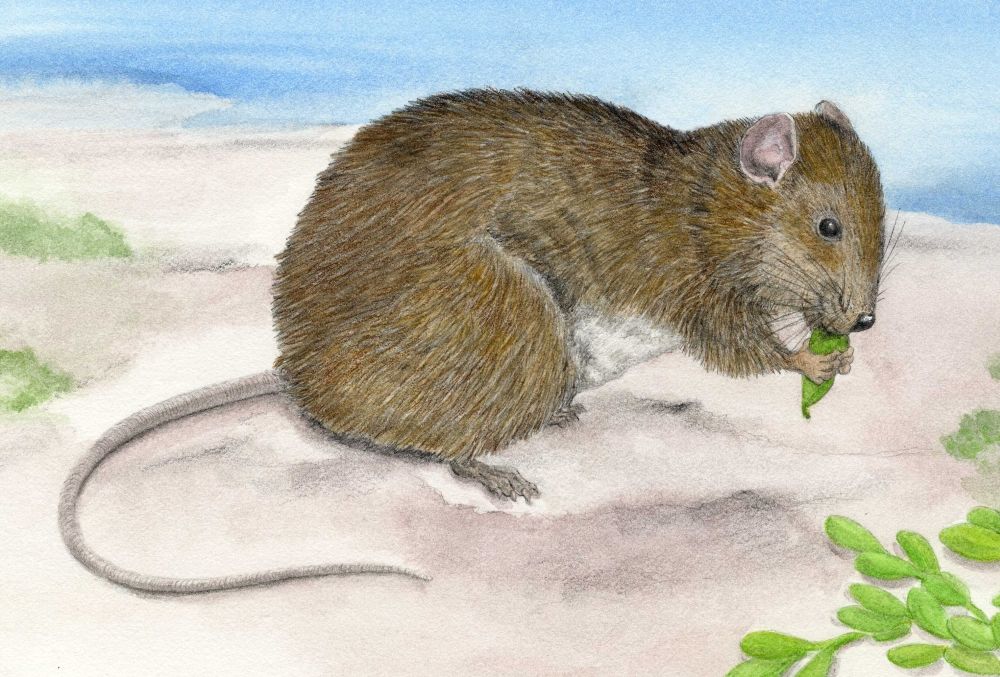
Bramble Cay Melomys
Latin name: Melomys Rubicola,Conservsation status: extinct (population is )
The Bramble Cay Melomys was a small rodent that lived and foraged in the vegetation of Bramble Cay, a low lying sandy island formed on the surface of the Great Barrier Reef. It was Australia's most isolated mammal.
The Bramble Cay Melomys was the first species to be declared extinct because of climate change. Sea level rise and storm surges washed away its habitat, food and the last of the population. In 2014 scientists went searching in the hopes of starting a breeding program but were unable to find a pair. Other sea birds and turtles that live on the Cay are also threatened by storm surges and sea level rise.
Other animals at risk

Ringed Seal
All populations of Ringed Seals are expected to be adversely affected by climate change because of dependence on sea ice and snow dens for breeding, protecting pups, moulting and resting. Early warming causes pups to separate prematurely from their mothers. As sea ice declines, other threats are fisheries by-catch, increased shipping, tourism and development. Seals are vulnerable to disease from heavy concentrations of pollutants that have accumulated in the Arctic food web.
All populations of Ringed Seals are expected to be adversely affected by climate change because of dependence on sea ice and snow dens for breeding, protecting pups, moulting and resting. Early warming causes pups to separate prematurely from their mothers. As sea ice declines, other threats are fisheries by-catch, increased shipping, tourism and development. Seals are vulnerable to disease from heavy concentrations of pollutants that have accumulated in the Arctic food web.
American Pika
Pikas live primarily in cool micro-climates on rocky slopes, feeding in adjacent meadows. Warmer temperatures and reduced snowpack are the main threats. Some Pikas may move to higher, cooler regions if there is enough vegetation. Pikas living in lower, warmer regions are at risk if they attempt to move to other regions as they are extremely sensitive to heat—more than two hours in temperatures over 78 °F can be lethal. Without enough winter snow for insulation, Pikas will freeze.
Pikas live primarily in cool micro-climates on rocky slopes, feeding in adjacent meadows. Warmer temperatures and reduced snowpack are the main threats. Some Pikas may move to higher, cooler regions if there is enough vegetation. Pikas living in lower, warmer regions are at risk if they attempt to move to other regions as they are extremely sensitive to heat—more than two hours in temperatures over 78 °F can be lethal. Without enough winter snow for insulation, Pikas will freeze.

Narwhal
The Narwhal lives mainly in the Atlantic Arctic. Because of specialized habitat, narrow range and limited diet (Arctic cod and halibut), it is one of the Arctic species most vulnerable to climate change. The Narwhal breeds in bays and fjords, moving offshore during winter to areas of heavy ice pack, breathing through the few cracks. Sudden or extreme temperature change can cause these cracks to freeze shut, trapping the whales. Other threats are illegal hunting, industrial activities, and risks from oil development, exploration and shipping in the Arctic.
The Narwhal lives mainly in the Atlantic Arctic. Because of specialized habitat, narrow range and limited diet (Arctic cod and halibut), it is one of the Arctic species most vulnerable to climate change. The Narwhal breeds in bays and fjords, moving offshore during winter to areas of heavy ice pack, breathing through the few cracks. Sudden or extreme temperature change can cause these cracks to freeze shut, trapping the whales. Other threats are illegal hunting, industrial activities, and risks from oil development, exploration and shipping in the Arctic.
Rusty Patched Bumble Bee
The Rusty Patched is the first bee to be listed as endangered in the US. Populations have declined as much as 87% from habitat loss, disease and pesticides. Climate threats include: warming and precipitation, early snow, late frost and drought. Bees and butterflies are important agricultural pollinators. In 2016, 40% of invertebrate pollinators (bees and butterflies) were listed as threatened with extinction.
The Rusty Patched is the first bee to be listed as endangered in the US. Populations have declined as much as 87% from habitat loss, disease and pesticides. Climate threats include: warming and precipitation, early snow, late frost and drought. Bees and butterflies are important agricultural pollinators. In 2016, 40% of invertebrate pollinators (bees and butterflies) were listed as threatened with extinction.
The Bramble Cay Melomys is at risk from climate change because of: