
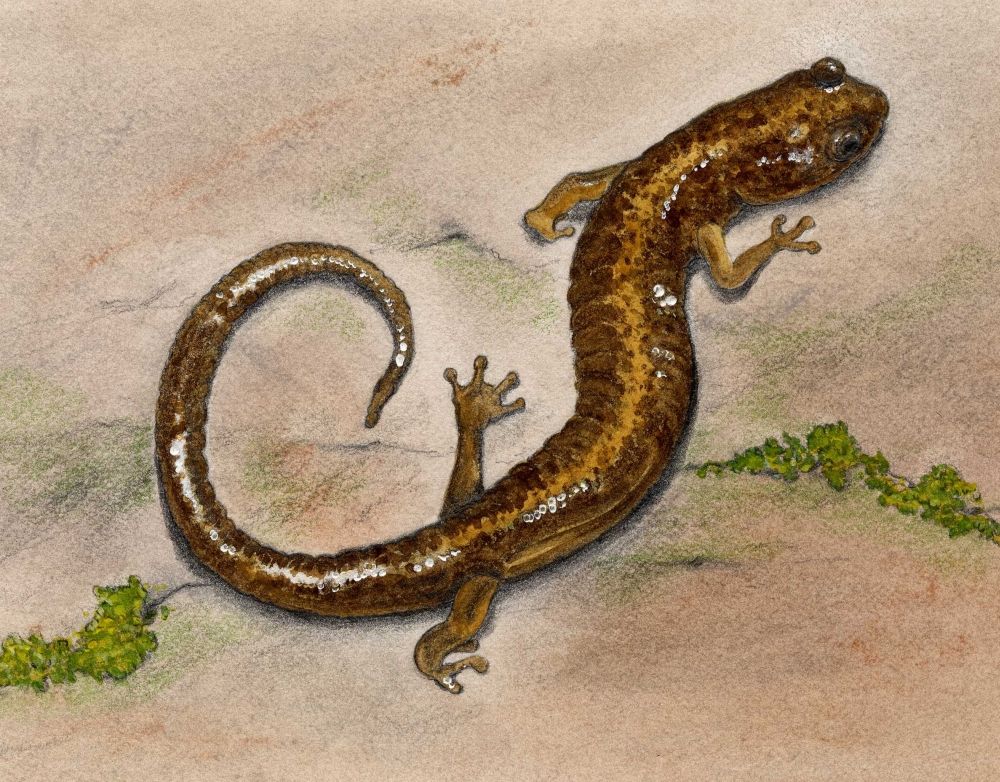
Shenandoah Salamander
Latin name: Plethodon Shenandoah,Conservsation status: vulnerable (population is stable)
The Shenandoah Salamander has no lungs—it "breathes" through its skin. A tail or toes lost to a predator will re-grow in a few weeks.
The Shenandoah Salamander lives in an isolated, high altitude region of Shenandoah National Park, USA. Like all amphibians who have thin, permeable skin, salamanders are very sensitive to environmental changes. If average temperatures or moisture increase, this salamander, restricted to its cool micro-climate, will be at risk—having no place to go but to lower, even warmer, altitudes. If warming causes other species of lower altitude salamanders to migrate higher, they will compete for the Shenandoah's cool, moist habitats.
Other animals at risk

Ringed Seal
All populations of Ringed Seals are expected to be adversely affected by climate change because of dependence on sea ice and snow dens for breeding, protecting pups, moulting and resting. Early warming causes pups to separate prematurely from their mothers. As sea ice declines, other threats are fisheries by-catch, increased shipping, tourism and development. Seals are vulnerable to disease from heavy concentrations of pollutants that have accumulated in the Arctic food web.
All populations of Ringed Seals are expected to be adversely affected by climate change because of dependence on sea ice and snow dens for breeding, protecting pups, moulting and resting. Early warming causes pups to separate prematurely from their mothers. As sea ice declines, other threats are fisheries by-catch, increased shipping, tourism and development. Seals are vulnerable to disease from heavy concentrations of pollutants that have accumulated in the Arctic food web.
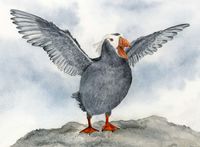
Tufted Puffin
Tufted Puffins are threatened by sea level rise and storm surges which destroy habitats and breeding areas. In some areas of North America warming seas are causing the fish that the Puffins feed on to migrate farther north, making it difficult for them to find adequate food. Other threats are entrapment in fishing nets, oil spills, pollution, ingestion of plastic, human disturbance of breeding colonies and introduced predators such as rats and foxes.
Tufted Puffins are threatened by sea level rise and storm surges which destroy habitats and breeding areas. In some areas of North America warming seas are causing the fish that the Puffins feed on to migrate farther north, making it difficult for them to find adequate food. Other threats are entrapment in fishing nets, oil spills, pollution, ingestion of plastic, human disturbance of breeding colonies and introduced predators such as rats and foxes.
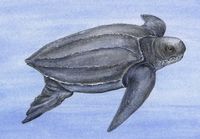
Leatherback Sea Turtle
Climate change impacts the Leatherback in two main ways: an increase in the temperature of nesting sands causes a greater proportion of females to hatch, destabilizing future populations; and sea level rise and stronger, more frequent storms erode nesting beaches and wash away eggs and hatchlings. The Leatherback is also threatened from fisheries by-catch, egg collection, coastal development, pollution and ingestion of floating plastics.
Climate change impacts the Leatherback in two main ways: an increase in the temperature of nesting sands causes a greater proportion of females to hatch, destabilizing future populations; and sea level rise and stronger, more frequent storms erode nesting beaches and wash away eggs and hatchlings. The Leatherback is also threatened from fisheries by-catch, egg collection, coastal development, pollution and ingestion of floating plastics.

Common Clownfish
Clownfish live in the shallow waters of coral reefs where they have a mutually beneficial relation with a few species of sea anemone. The anenome protects the Clownfish, and the fish's swimming aerates the water around the anenome. Clownfish are unable to move long distances, and rising ocean temperature and acidity is a threat to their coral reef habitats. Increased acidity also seems to impair their ability to navigate to their home anemones.
Clownfish live in the shallow waters of coral reefs where they have a mutually beneficial relation with a few species of sea anemone. The anenome protects the Clownfish, and the fish's swimming aerates the water around the anenome. Clownfish are unable to move long distances, and rising ocean temperature and acidity is a threat to their coral reef habitats. Increased acidity also seems to impair their ability to navigate to their home anemones.
The Shenandoah Salamander is at risk from climate change because of: